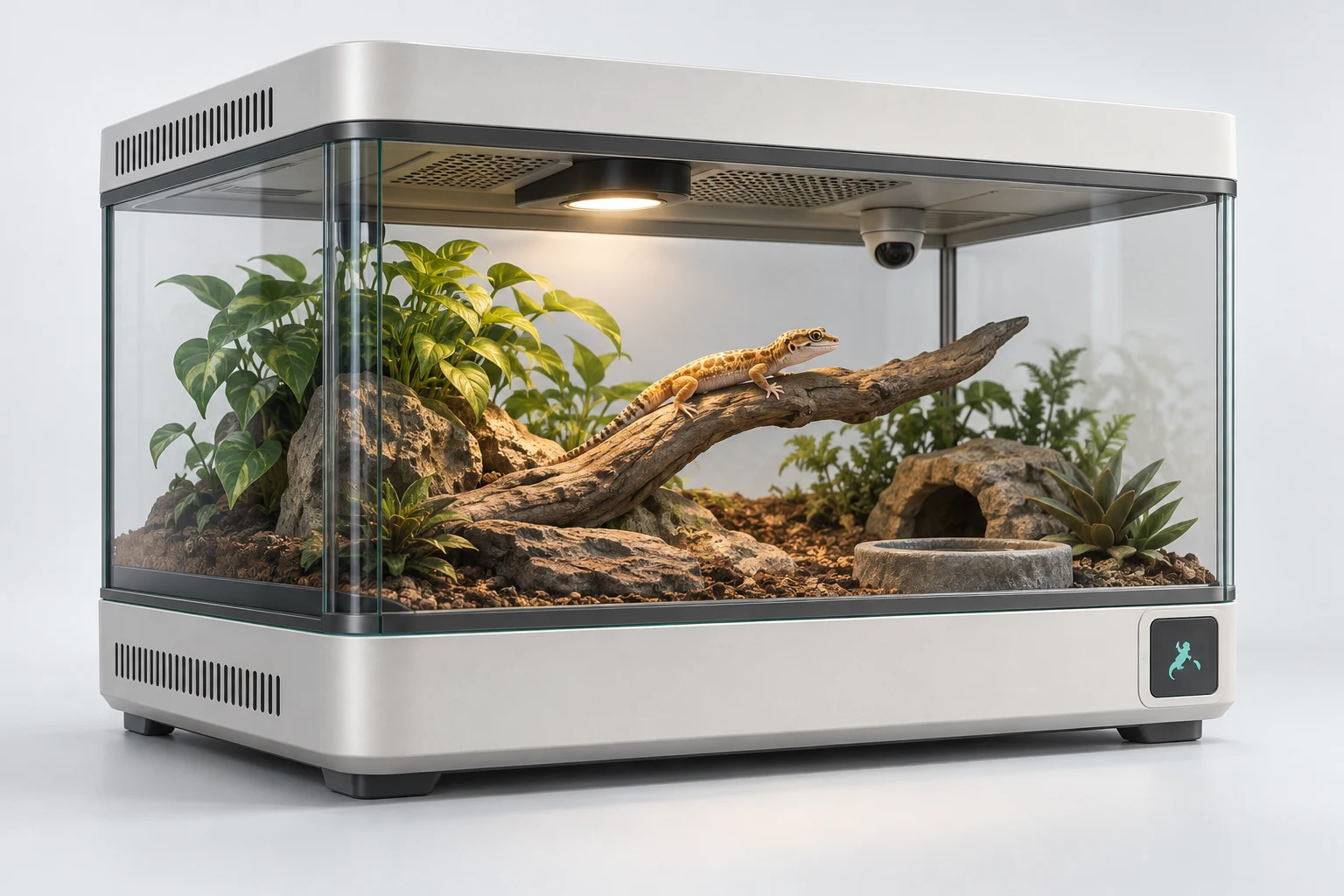
Vision and environmental-control concept for a smart habitat
Video observation and local environmental regulation must work together. The concept defines hardware, driver and application responsibilities, with control, protection and validation planning; prototype implementation has not started.
Project stageConcept and solution design; prototype implementation has not started
Smart habitat concept rendering, not a photograph of a physical prototype.
Project overview
Product / platform
Smart habitat terminal evaluated around RV1106
Proposed responsibilities
Linux multimedia and networking, with local environmental control on an independent MCU
Engineering focus
Environmental regulation, fault protection and planning for later installed validation
What the product needed to solve
Video, animation, audio and networking share device resources, while environmental regulation must remain locally controlled and coordinate heat, cooling, misting and airflow.
Engineering approach
How the engineering work fits together
01
Separate multimedia tasks from local control
Evaluate a mature core board and custom carrier board for Linux capture, encoding, animation, audio and networking, with an independent MCU considered for sensing, actuation and local control. Board choices and concurrent resources remain to be validated.
02
Include fault handling and recovery in the architecture
Plan responses to water shortage, leakage, probe faults, fan blockage and process loss, alongside temperature limits and default-off drive protection. Offline operation is a design requirement that still requires physical validation.
03
Define installed validation and delivery boundaries first
Plan checks of media concurrency, resource usage, environmental behavior and fault recovery using actual peripherals, media and the final enclosure. Cloud services, apps and model training are separately scoped.
Engineering evidence
See the material, its purpose and the limits of what it demonstrates
Proposed architecture diagram
Proposed relationships redrawn from project material; board choices, responsibilities and concurrent resources remain to be validated.
Prototype implementation has not started. The diagram shows proposed responsibilities, not verified control performance, continuous operation or fault protection.
What the project has produced
Requirements and architecture planning
Proposed responsibilities for vision, multimedia, networking and local control as input to detailed design.
Control and protection approach
Design requirements for environmental regulation, offline operation and fault handling, rather than verified functions.
Installed-validation framework
Planned scenarios and evidence using the actual enclosure, peripherals and environmental conditions.
Engineering foundation
The concept defines responsibilities for vision and environmental control, local operation and protection, and a validation framework for interaction, regulation, recovery and continuous operation.
Validation scope and limits
This is a solution-design case. Concurrency, control thresholds, continuous operation, fault protection and delivery must be verified during implementation.
This case presents project materials and stage outcomes. Deliverables, test conditions and acceptance scope are confirmed for the agreed project version.